Comparison of Techniques for Process Scale Column Packing
07 Aug 25
By:
“I had been told that the training procedure with cats was difficult. It’s not. Mine had me trained in two days.”
— Bill Dana
Column packing at process scale has often been referred to as an art instead of a procedure because there can be a lot of variables, and small differences in the quality of a packed bed can have big consequences on your chromatographic performance.
Column packing procedures should be optimized to ensure a well-packed column with uniform distribution of resin. The benefits of a well-defined procedure for column packing include:
At laboratory scale, packing chromatography columns is fairly straightforward. Just remove the top adapter, pour in your resin slurry, apply downward flow to consolidate the bed, and push the top adapter down. Sure, there are a few exceptions, but for the vast majority of resins this technique is the norm.
For large scale chromatography, it’s impractical to remove the top adapter to pour slurry into the column. As columns increase in diameter to accommodate process scale manufacturing, the top adapter becomes too heavy and cumbersome to easily move in and out of the column. Furthermore, there is an unacceptable risk of contamination with open columns in a GMP suite.
Thus, “pack-in-place” columns were introduced for process scale chromatography. The technique for packing differs depending on the type of column.
“Stall packing” columns were among the first to be introduced. For these columns, the headplate is fixed at the desired bed height and does not move. The slurry is transferred into the column using a diaphragm pump at a high flow rate. The mobile phase (i.e., packing buffer) exits through the process frit, while the resin is trapped in the column, creating a packed bed. This type of packing compresses the resin inside the column until the pump “stalls,” meaning that the pressure inside the column exceeds the supply pressure of the diaphragm pump. At that point, no additional slurry can be packed into the column.
One of the disadvantages of stall packing is that for several types of chromatography resins, it can create a non-uniform bed where the most densely packed parts of the bed are either against the column wall, or close to the central spray nozzle. It’s also really difficult to transfer packing protocols from laboratory to manufacturing scale because of such a huge difference in procedures.
For this type of packing, the top adapter must be mobile and the height of the column tube must be at least two times the desired bed height. The slurry is gently transferred into the column through the slurry valves, either with a diaphragm pump at low pressure or using the top adapter like a syringe to pull the slurry into the column. After the slurry transfer, the packing procedure is similar to the one used at laboratory scale – that is, you apply downward flow at a linear flow rate that is higher than your processing flow rates to consolidate the bed. After the slurry is fully consolidated, you can lower the adapter to the desired bed height based on the vendor-recommended compression factor or packing factor.
Sometimes, it may take a few cycles of high flow followed by lowering the adapter in order to get to the final desired bed height.
Although the procedure for flow packing is similar to that used for laboratory scale, the main disadvantage is that most flow distributors on larger columns are designed to be against a packed bed. Thus, there may be some inconsistencies in flow across the cross-sectional area of the column if the adapter is positioned high above the bed. Secondly, the procedure for flow packing can lead to a non-uniform bed if there are too many cycles where the bed is allowed to rebound from its compressed state before the adaptor is lowered to its final position.
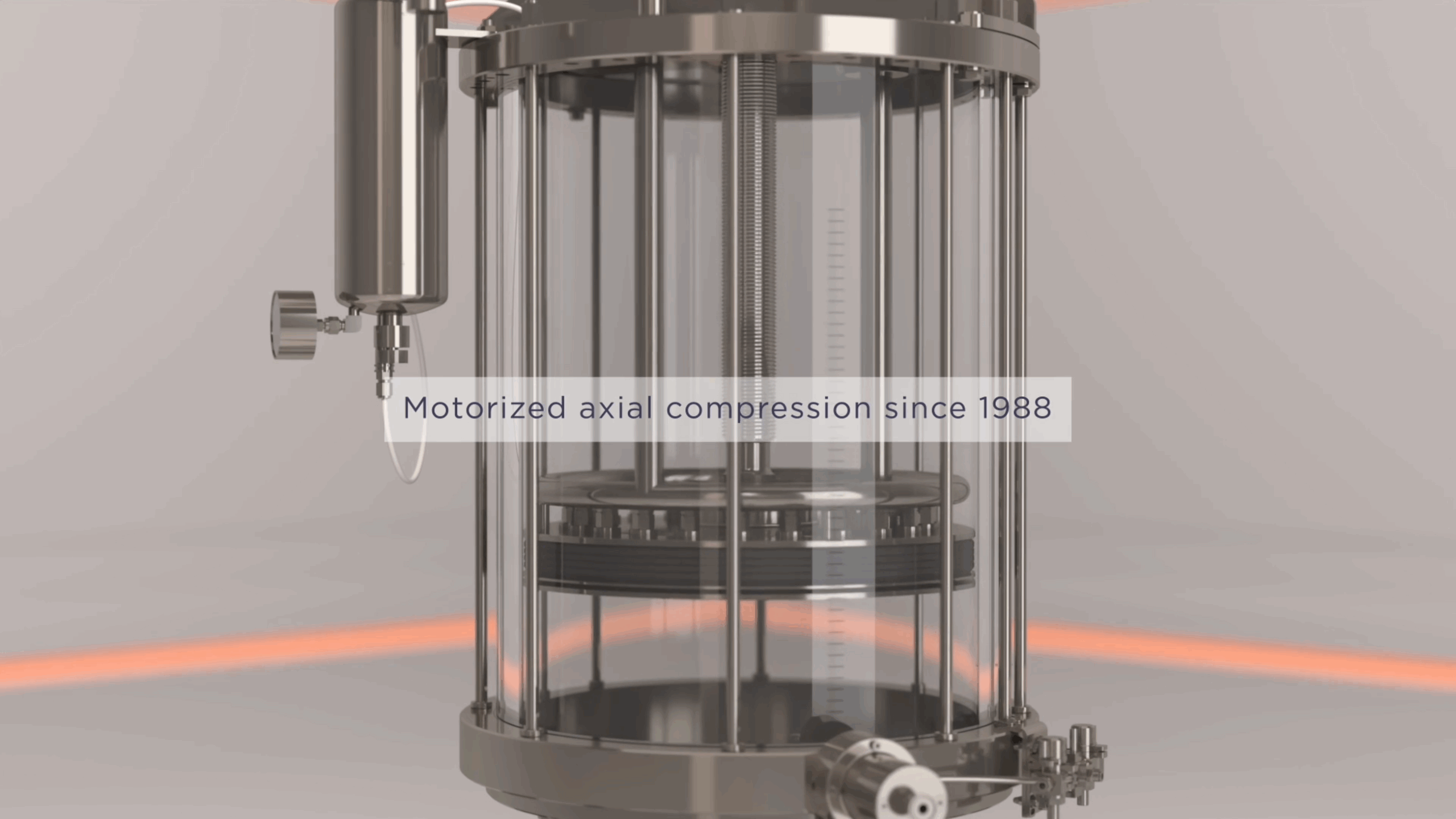
Axial compression packing is similar to flow packing, especially for the slurry transfer step. However, instead of initiating downflow after slurry transfer, the top adapter is lowered at a linear speed similar to the flow rate used for flow packing. In this case, the bed is consolidated by the downward movement of the top adapter. A combination of downward flow and adapter movement can be used, but flow is not necessary.
With axial compression packing, the force applied to the bed is evenly spread across the entire cross-sectional area so there are no pockets of inconsistency as can be experienced with flow packing. When combined with a motor and control console, the final bed height and compression can be controlled with millimeter accuracy.
Axial compression is the natural evolution in column packing for large scale manufacturing. It is the most similar to laboratory column packing procedures, so the protocols are easy to scale up during tech transfer. And with well-defined procedures, your chromatographic separations can have better efficiency, resolution, and reproducibility.
The VERDOT® InPlace™ and EasyPack™ columns feature motorized axial compression packing to optimize bed performance.
 Kim Brisack is the Global Applications Support Manager for VERDOT and in that role, she has worked with companies all over the world. She has extensive experience in GMP downstream operations for almost thirty years, including roles in PD and MSAT at Bayer Healthcare in Berkeley CA as well as R&D Applications and Marketing for Process Chromatography at Bio-Rad in Hercules CA. Based in San Francisco CA, she spends her free time at her ranch near Yosemite National Park with her partner and five dogs, two cats, and three horses.
Reach out to learn more about how we can help you with your downstream processing needs.